Posts Tagged ‘moss rock’
The Bay Friendly Garden Tour

One of the gardens that we help maintain is on the Bay Friendly Garden Tour tomorrow. I’m a big fan of the tour and the whole concept of ‘Bay Friendly’. It’s such a clear way to focus on the ecological implications of gardening, and the tour has the feel of real gardens made by actual gardeners. This garden was originally installed by a designer (Roger Raiche, who’s known around the Bay Area from working at the UC Botanical Garden and for introducing a lot of well-known native plant varieties, Vitis californica ‘Roger’s Red,’ California Wild Grape, being the first one that comes to mind but there are many many more) and we’ve been helping with the maintenance for several years, but it’s very much the owner’s own personal garden. Over the years, she has moved and added and subtracted a lot of the plants, and she’s the one who keeps it in a showcase state.


This section of the garden was designed by her along with a Buddhist monk who helped in the garden before our tenure. Virtually every plant in this area is a transplant from some other part of the garden, almost no new plants were bought for the space. Quite a few classic garden plants — roses, rhododendrons, azaleas, a peony — ended up in this area, I think after struggling or being overcrowded somewhere else. The fence was built with bamboo that the monk harvested from my garden. They instilled the space with a nice peaceful ambience, and it’s my favorite place to sit in the garden. Every garden should have a Buddhist monk work in it for a time.

I’ve posted photos from this garden a couple of times before, here and here. There is a post about the garden on the Bay Friendly blog and the garden got several paragraphs in a write-up of the tour at SF Gate. And Floradora has a number of nice photos from this garden and several others on the tour.
Some more photos are below. (more…)
The UC Botanical Garden, Late February

I went to the UC Botanical Garden yesterday. Anita and I decided to get memberships for the year. We realized that the garden is actually quite close to our house, not quite as close and convenient as the Tilden garden, but almost, and we should get to know it better. This was the first visit of the year. The garden was in transition between winter and spring, the earliest plants in leaf but most of the other deciduous plants still dormant.


The South Africa section has a new section of moss rock wall. Really nice stonework, dramatic contrast between the boulders and the walls. Be interesting to see what they plant, something with an intense flower no doubt, based on everything else in that section. I think it’s my favorite section of the garden.


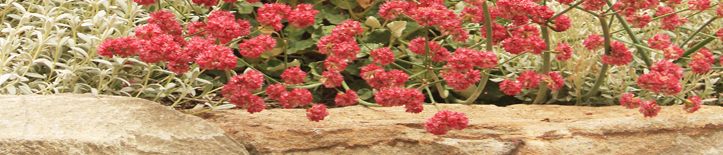
It’s hard to think of a flower like this as the natural bloom and not a cultivar that has been bred by humans, but the UC has only wild collected seed.


I don’t remember noticing this vertical stone before. I think that’s a flowering quince behind it.

The ceanothus were going in the native section, but a lot of the other spring bloomers were just getting ready to break. Like the Tilden garden, the UC is a little later than my more coastal garden.


The Summer Holly, Comarystophylis diversifolia, was covered in buds. I’m not sure I’ve ever seen one in full bloom. The Oso Berry, Oemleria cerasiformis, is another one that I don’t often see in bloom.

And there is patch of Giant Coreopsis, the star of my recent bloom day, looking like they wandered over from the South Africa section. Such a strange plant; it’s very clear to me why I need one in my own garden and why I’ve never planted one for anyone else.

The Cracked Pot Moss Rock Wall

Moss Rock
I was recently back at a garden where I did a day of rock work last summer, a short section of moss rock wall along a sloping path. When I built the wall, the client and I incorporated a couple of cracked pots into the wall where it tapers into the slope, and then she transplanted a number of her succulents to plant along the wall and in the pots. It’s one of our only gardens in which the client is also a gardener, and it was nice to now see how her planting has begun to fill in. The plants in the cracked pots still need a little more time to spread, but I think they already look pretty cool.

Moss Rock with Cracked Pots
The wall in the background was already there, built by the company who installed the garden five years ago. I like the choice of aloes to plant along the top of it; they do well there, and their pokiness discourages people from messing with the rocks.

One of her containers
The garden is quite spectacular and worthy of a longer post some day. There are always things blooming and I usually take a few photos while I’m there; the shots of the swallowtail and prostanthera in my last post are from this garden. When the prostanthera is done, this member of the aster family will be in full bloom. I’m not sure what it is, but I like the look of the flower buds, and when it gets going, it puts on quite a show. Does anyone know it? I would try to figure it out, but the aster family is mighty big.

Some kind of Aster

The Aster with Coleonema last May or June
Categories
- bay area (7)
- miscellaneous (13)
- plants (69)
- california natives (34)
- bulbs (2)
- wildflowers (10)
- edibles (3)
- trees (14)
- california natives (34)
- private gardens (34)
- lawn to garden (12)
- public gardens (49)
- tilden (9)
- UC Berkeley (3)
- sculpture (32)
- sketchbook (39)
- stone (74)
- sustainability (4)
- trails (13)
- various critters (5)
- wildlands (15)
