Archive for the ‘wildlands’ Category
Bouverie Preserve

I also went out to the Bouverie Perserve in Sonoma. It’s a 535 acre preserve that’s only open to the public for guided walks a few times a year. It’s a great property. I’m glad I got a chance to see it.

I had heard about the Bouverie Preserve on a list of places to see California wildflowers, but I may have been there late for the peak bloom. I saw dozens of Calochortus amabilis, one of my favorites, and a nice patch of Chinese Houses, another favorite, so I wasn’t disappointed. I also saw Blue Dicks, a few Clarkia purpurea had opened, and a lot of Owl’s Clover was scattered throughout the grasses.


Instead of wildflowers, it was a great place to see oaks. Beautiful oaks.


One of the trails ran along a creek that still had water flowing at the end of April. The tapestry of ferns alongside the trail was even better than the oaks and wildflowers.


Shell Ridge Natives

During the wildflower season, I spent a few hours pulling weeds at a restoration project at Shell Ridge Open Space in Walnut Creek. It’s a compelling, though still somewhat nascent, project, a steep slope facing the entrance of the open space. Most of the restoration work has happened in the last few years. The plants are young and there’s quite a variety of species, including a number of beautiful bunch grasses — Poa, Nasella, and Koeleria, maybe a few others — but the biggest visual impact came from the annuals that were blooming — California Poppies, Chinese Houses, and to lesser extent a Phacelia that I hadn’t seen before, P. distans which was popular with the bees but not really photogenic or garden worthy.


I loved the big patches of Collinsia heterophylla. I tried to grow them in my garden this year, but they didn’t do well, I think because of slugs and snails.

Other areas have been more recently cleared and planted. That’s a great looking oak; it will be beautiful with wildflowers filled in around it.

There’s a former quarry across from the restoration area. From a distance the quarry shows like a scar, but it’s a nice landscape up close.


Some of the boulders display the shells that presumably inspired the name Shell Ridge.


I hadn’t been to Shell Ridge in years, so it was great to be lured out by the restoration project. It’s a pretty classic California landscape, lovely grassy hills, and I’ll be sure to go back see how the restoration project continues to progress.
Cataviña Boulder Gardens

Death Valley and the ‘super bloom’ was just one stop on the trip, we spent the bulk of our time south of the border in Baja. We revisited Cerro San Ignacio, an amazing spot that deserves an interpretive trail perhaps more than any other site in the world. But we’d been there once before; the botanical highlight of this trip was the Boojums. Boojums! I’d wanted to see the boojum forests for years.

We did our boojum viewing amongst the boulder gardens around the oasis town Cataviña, a beautiful area with pinkish granular granite reminiscent of the rock at Joshua Tree (there’s apparently good climbing on some of it, too). Some of the boojums had strange curlicues at the top like something out of Dr. Seuss, but my favorites were the graceful upright ones. There’s something illogical about them, as if the plant got confused and put it’s taproot in the air and it’s branches underground.


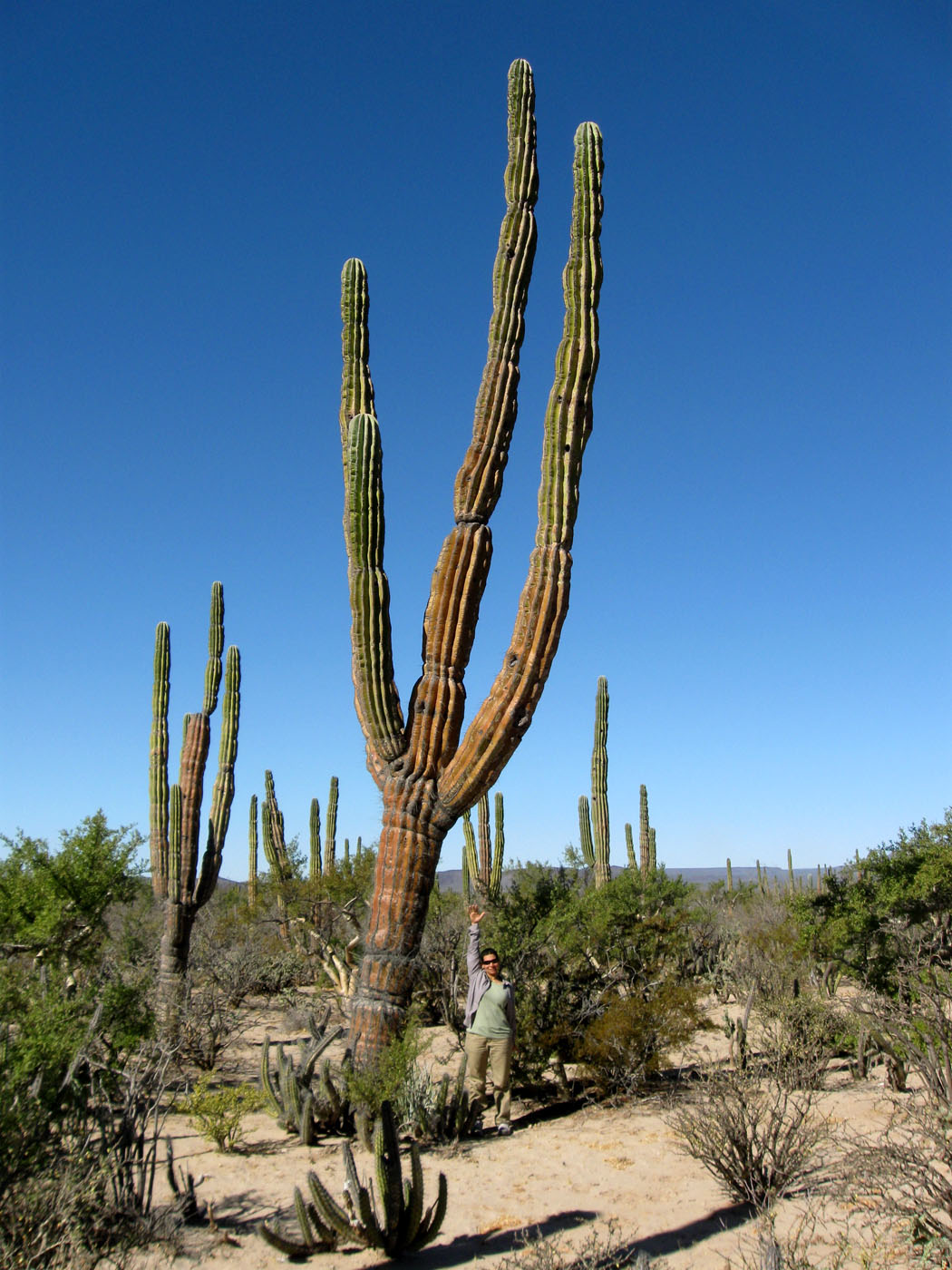
The area also has tremendous Cardón cactus trees.

Elephant trees are another favorite. A little bit like small oaks from a distance, but with striking caudiciform trunks up close.

As with any great rock garden, in some places the plants were a compliment to the rocks and in other places the rocks were a compliment to the plants.


There were plenty of showy flowers tucked amongst the rocks and arroyos. A few of my favorites are below. (more…)
Joshua Tree Revisited

After the garden show I went down to Joshua Tree for a week of rock appreciation, for which there is no better place. There was a small amount of wildflower action to appreciate along with the rock, but not much. This Echinocereus was shockingly intense wherever it was in bloom, but even pulling back out a little shows what a small bit of color it offered in a relatively monochrome landscape.


The main excitement was with the rock. So many beautiful rock formations. I took photos of a few of the features that reminded me of dry-stone work.


The rock above looks like it was split by a team of giants at the end of the work day and left ready to be installed the next day. It’s uncanny how cleanly some of them are split.


And at the end of the day, it’s all amazing for climbing. One of my favorite landscapes in the world.
Saguaro NP and Organ Pipe Cactus NM

I got back from my road trip a little while ago. It was great. Much colder than I expected, but Anita says it was also cold around here. I started in the Tucson area, visiting a friend and doing a little bit of climbing. I spent a couple of days hiking at the lower elevation parts of Saguaro, a couple more hiking at higher elevations in the Catalina Mountains east of Tucson, and one day hiking in the Santa Rita Mountains about an hour south. I also went to Kartchner Caverns and Colossal Cave State Park, and spent a day at the Sonora Desert Museum. The Desert Museum was great; I went to several botanical gardens on the trip, but I’ll put those photos in separate posts. These photos are all from Saguaro and Organ Pipe.

It was my first time in that part of Arizona. I found there was a lot of overlap with plants I knew from Baja or Southern California, but with subtle differences. I hadn’t seen saguaros before, just Cardons, the Baja equivalent. I like the saguaro skeletons almost as much as the living ones. I was surprised at how many of the plants I recognized when I went up to higher elevations, to the grass and oak woodlands. There was an Arizona version of sycamore, rhamnus, rhus, and madrone, and more species of scrubby oaks than I could keep track of.

The Ocotillos were my favorite plant there. I know them from when I went to school in San Diego and would hike in Anza Borrego State Park. I think they’re the first desert plant that I ever loved.


—————

After Saguaro and the other Tucson parks, I went to Organ Pipe Cactus National Monument on the border with Mexico. It has a lot of the same species as Saguaro, but it’s also the one part of the US where Organ Pipe Cactus and Senita Cactus make it up across the border. It might sound strange to call the desert lush, but the area where I camped, Alamo Campground, was noticeably more lush than where I hiked in Saguaro, with more foliage on the plants and a lime-green cast to to the silver-leaved foliage. It was also the one place in Arizona where I saw leaves on some of the ocotillos. It could be because the soil was redder, with more iron in it, or maybe the area had received a little more rainfall. The weather had warmed up after the cold snap in Tucson, so it felt almost tropical.


I hadn’t thought too much about Organ Pipe being on the border, but in the past decade the park has had a lot of problems with drug traffickers. There doesn’t seem to be as much trouble now, but that’s because just about every third person or vehicle in the park is Border Patrol. There are a couple of checkpoints just outside the park and one guy came around to my campsite and spent some time questioning me about what I was doing in the area and what was in my truck and so forth. And while I was hiking I found a stash of about forty empty water bottles that were obviously used either by drug runners or undocumented immigrant groups, so there is obviously still activity. At first I was happy to be the only one at the little campground, but by the time I left I had much less confidence in my solitude. Rather different from my usual national park experience.

While the Border Patrol guy was filling out his report on me, I made a sketch of his truck.

It’s one of the prettiest little patches of desert I’ve ever visited, though, and I wouldn’t hesitate to go back again. The photo above is pretty representative. It’s best if you click to see it larger.
You are currently browsing the archives for the wildlands category.
Categories
- bay area (7)
- miscellaneous (13)
- plants (69)
- california natives (34)
- bulbs (2)
- wildflowers (10)
- edibles (3)
- trees (14)
- california natives (34)
- private gardens (34)
- lawn to garden (12)
- public gardens (49)
- tilden (9)
- UC Berkeley (3)
- sculpture (32)
- sketchbook (39)
- stone (74)
- sustainability (4)
- trails (13)
- various critters (5)
- wildlands (15)