Archive for the ‘walls’ Category
Mallorcan Dry Stone Walls
Posting about the angled stone wall in this year’s garden show seems like a good excuse to post about the Mallorcan style wall we did with Mariposa Gardening and Design in the show last year. It’s not as eye-catching as the angled stone, but the building style is unique in its own way. Personally, I didn’t lay a single stone on the wall–I was a bit skeptical about building a wall and then taking it apart five days later, part of the reason I like stone is that it is the longest-lasting building material on earth, so instead my contribution to the garden was flagstone steps that I could afterwards re-install in a real garden–but it was a nice wall and it deserves to have some internet presence. A lot of the stuff in the garden show is just facade work, but the crew built a real wall, thirteen tons worth, pretty cool and pretty crazy.
Mallorcan walls are also sometimes called polygonal walls because they use five-sided stones laid in an arch pattern; traditional walls use four-sided rectangular stones laid in linear courses. One of the sacred rules of traditional walls is to break every joint, but with a polygonal wall the joints zigzag enough that the rule doesn’t apply. Instead, the rule for a polygonal wall is to have every stone touched by five others. Instead of trying to create a flat surface for the next stone, you try to make a cradle for it, and instead of vertical and horizontal lines, you create arches. The idea is that the adjoining stones form an arch around any given stone, so if that stone falls out the other stones will still hold together and the wall won’t fail. In theory, if you pick a stone, you can see a little arch of other stones around it.
The walling style is really effective at making tall, strong, long-lasting walls out of irregular stone. Mallorca is full of walls hundreds of years old, and examples I’ve seen on the internet are often ten or twenty feet tall. To work on the walls, workers pound metal bars between the stones and then put boards across the bars to act as scaffolding. A lot of the walls are pretty rough looking but at the same time really appealing because of their size and strength. The walls get capped with European-style vertical coping stones, which adds a nice touch of style and self-consciousness to the rather rough, naturalistic stonework. Our wall in the garden show was made with Napa basalt, the closest Bay Area equivalent to the limestone they have in Mallorca.
The Stone Foundation has a beautiful Mallorcan wall in their write-up for the 2007 workshop and another in their write-up for the upcoming 2009 one. DryStoneWalling has photos of two walls, one that’s retaining and one that’s freestanding. Below, I put one of my sets of flagstone steps with a section of Mallorcan cheek wall.
Angled Dry Stone Walls
I wanted to post a few more photos of the freestanding wall from the garden show. I haven’t seen many walls with the courses running at an angle, and none quite like this one. To lay the stones at an angle goes against the “rules” I learned about building walls, but, apparently, stoneworkers have been doing it in Cornwall for centuries. The Cornish call their walls “hedges”, and do things like cover them with sod, and they have a whole tradition of stacking slate vertically or at an angle. Their slate doesn’t support weight well when stacked horizontally, so they turn it on its edge, which makes a certain amount of sense; I’ve worked with slate which would crumble from a single hammer blow across the flat, but could withstand repeated blows against the narrow edge. The Guild of Cornish Hedgers has a collection of photos including some walls built with a herringbone pattern. I particularly like this one with stiles for climbing over it. There’s a photo on a blog here and another photo in the Cornish collection in the Dry Stone Walling Association of Great Britain gallery.
Through the magic of turning the camera sideways, you can see that the wall is built with courses like a traditional wall, just that the courses run at an angle.
The horizontally laid stones of the arch set the angle for the slanted courses. A lot of the wall’s weight is going to be pushing against those horizontal courses and against that arch, but arches are strong and the wall could have stood for a lot longer than the five days of the garden show. Now it only exists in memories and photos.
The Dry Stone Walling Association of Canada has more photos of the wall on their site, and photos of another angled wall they built for a garden show in Canada last year.
WallsWithoutMortar has photos of another angled wall built in Danville, here.
I stuck a couple of detail photos of the arch below. (more…)
Cabernet Stone Terracing
It seems like whenever clients call us about terracing a slope on their property, the slope is actually too steep to terrace with dry stone. The slope usually turns out to be steeper than 1:1, one foot of vertical for every foot of horizontal (a quick way I estimate is to stand on the slope and measure or eyeball the distance straight out from my shoulder, my shoulder is five feet high, so if the distance to the slope is five feet then the ratio would be 1:1, ten feet would be 1:2, fifteen feet would be 1:3, and so on; if the distance to my shoulder is less than five feet the slope is too steep), and that math just doesn’t lend itself well to dry stone retaining walls, which rely on their thickness and weight to hold back the weigh of the slopes they retain. For instance, a two foot high wall needs to be a foot thick at the top, so if your wall rises two feet on a 1:1 slope, it only creates two horizontal feet and one of those feet will be taken up by the wall; your net gain is only one foot of flat planting space. It’s rarely worth the money or effort, so we usually end up building a wall at the base of the slope and then planting the rest of it with plants that thrive on slopes.
This little planting in San Francisco is the first time we’ve actually terraced a slope, though, in reality, it barely qualifies as terracing; it’s more like one wall split into two shorter walls. We could have built it as a single two and half foot high wall. But because the whole planting is at eye level on top of a thick concrete retaining wall, we didn’t want to be adding another giant wall to further loom over people. So we split the wall into two separate walls and then further softened the impact of the stone by setting the lower wall back from the concrete to create space for plants.
For the plants, we chose ones that are soft textured, drought-tolerant and mostly native to coastal California. A few of them are considered rock garden plants, a somewhat subjective term, but typically rock garden plants like sandy or gravelly soil, tolerate or enjoy reflected heat from stone, have a smaller size, and are best appreciated up close and at eye level, all elements of this planting. And then a few of the plants like the Myrica and the Phormium are standard landscaping plants for San Francisco. A photo of the whole little planting and the plantlist is below. (more…)
Dry Stack Stone Wall Repair
Before and after photos of a dry stack wall we recently repaired. The original wall was built about fifty years ago with just a single rock type, and then at some point the red and grey river stones were added, probably during a repair job but also possibly because someone wanted to borrow stones for another one of the walls on the property.
The big issue obviously was the two cedar trees, which had pushed the wall apart and partially swallowed many of the original foundation stones. A few of the stones were literally engulfed by the root/trunk of the trees; we had to leave those embedded stones in place and just stack in front of them. We moved the wall forward six inches, added a gravel foundation and gravel backfill, and scavenged the yard for enough of the original moss rock to restack the wall with a single rock type, discarding the river stones. By the end of the day, we had just a single leftover rock about the size of a softball; every single other moss rock that we could find on the property had been used in the wall. Eventually the trees will push the wall apart again, but then it can be stacked one more time.
Last December we were hired to do a similar repair on another fifty-year-old wall that had been pushed over by a redwood tree. The difference with that wall, though, was that it had been built (poorly) with mortar. To repair that wall, we had to demolish it with hammers and we were unable to salvage almost any of the stone; it was fit only to be re-used as rubble backfill and we had to buy a pallet and a half of new stone. So the repair job became a replacement job. And, of course, it also became much more time-consuming and expensive, taking three times as long and costing four or five times as much money. It’s a big factor to consider in debates about mortar versus dry stack: mortared walls stand up well for a long time, but when they do eventually need repair work, it becomes a much bigger job to repair them and they frequently need to be completely replaced. Dry stack walls do typically need to be repaired more often, but those repairs are also typically much easier and much cheaper over the life of the wall.
ryan 12/7
Black Lichen Stone
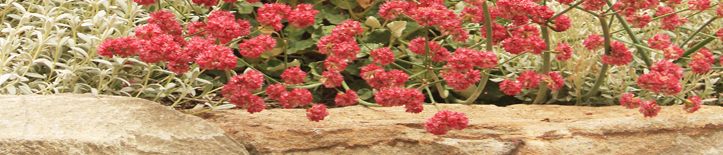
The wall stone in the header is called black lichen, a stone from Oregon. We planted erigeron (S.B. daisy) and woolly thyme in a few of the joints. Erigeron isn’t one of my favorites, but the client liked it, it was already in the yard, and it has the toughness to thrive in a wall. She said in Switzerland it’s called “thousand beauties.” I ‘m skeptical of Santa Barbara daisy, but I guess I am willing to plant “thousand beauties.” More details from that wall below.
You are currently browsing the archives for the walls category.


